01 / A SHARED PROPORTION
Pitch and duration,
conceived together.
A mode is usually introduced as a collection of pitches. Stoianov’s system asks a further question: what happens when the organisation of pitch and the organisation of duration follow the same proportional logic?
Building on Wilhelm Georg Berger’s work on modal structures and the golden section, Stoianov extends the approach into musical time. The numerical sequence 2, 3, 5, 8, 13, 21, 34 helps organise both the spacing of pitches and their durations. He identifies Proporții 1 as the threshold into this approach.
The chosen units matter. On the pitch axis, one unit may be a semitone; on the duration axis, it may be a sixteenth note. The numbers therefore describe musical distances and durations in specified units—not literal frequency ratios in hertz.
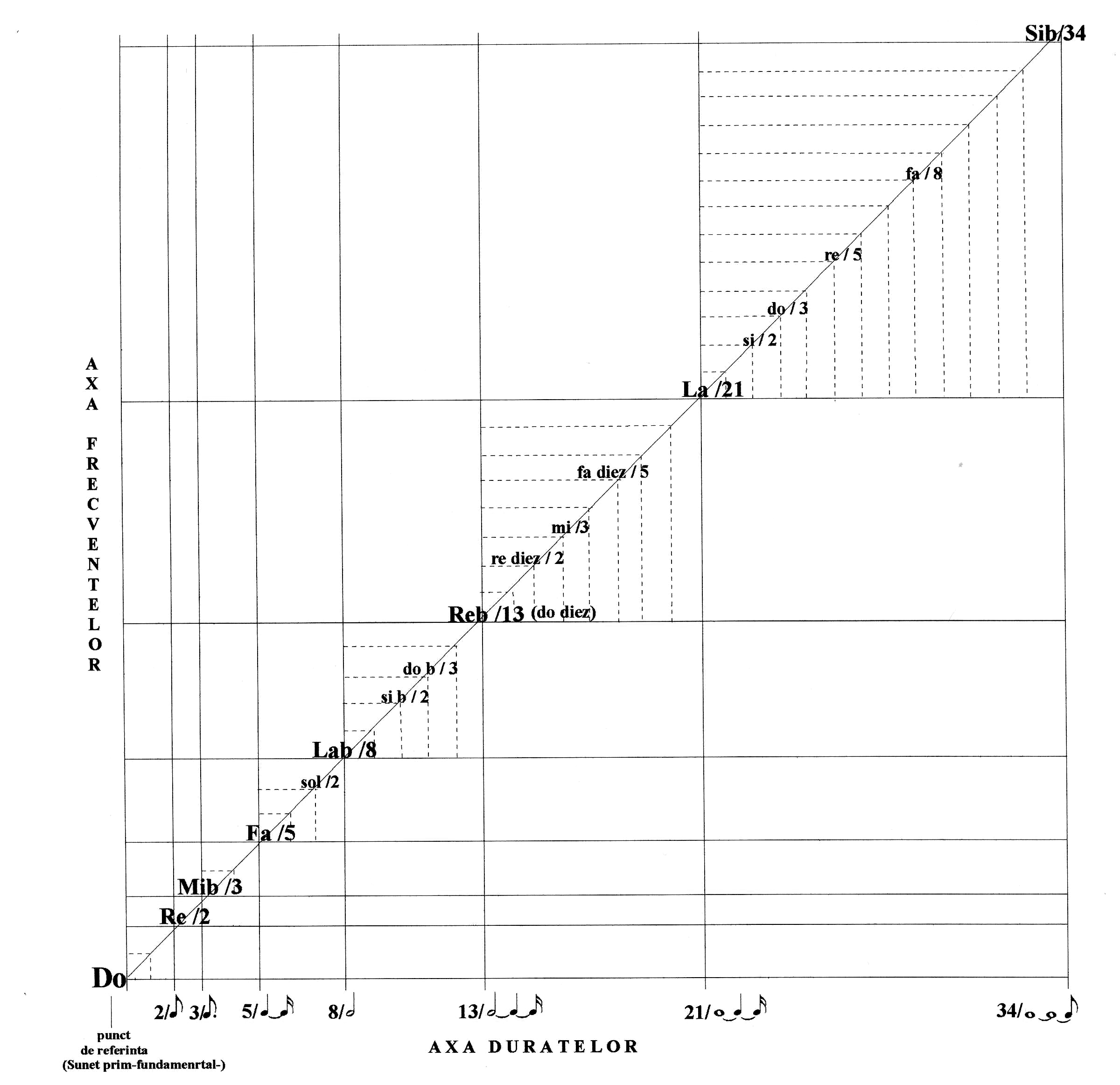
“The Stoianov Modal System” is the descriptive title used here for his approach. It acknowledges his extension of Berger’s modal research and his dialogue with Anatol Vieru’s thinking on time and space.
02 / NODES & SIGNS
A point of stability.
A space for invention.
Nod · Node
A pitch and a duration joined by a determined proportional relationship: an identifiable point of reference, with its own sonic identity.
Semn · Sign
The unfolding of that potential through ornament, subdivision and transformation. Stability gives rise to movement and difference within the system.
The Romanian word nod also means “knot”. That double meaning is useful: a knot binds elements together, but can also be untied. The thesis connects these musical ideas with the poetic world of Nichita Stănescu.
03 / MUSICAL WINDOWS
Another world
inside the first.
The space between structural points is not empty. Stoianov treats it as a “window”: a place where smaller, related modal patterns can unfold. They may use a different unit or distribution while preserving the governing proportional principle.
These internal structures can be simple ornaments or contain further ornaments of their own. A passage can move away from a local mode and return to it while remaining inside the larger system. This is why his theory allows flexibility and changing colour rather than prescribing a single fixed scale.
EXPLORE A DURATION
One span. More than one interior.
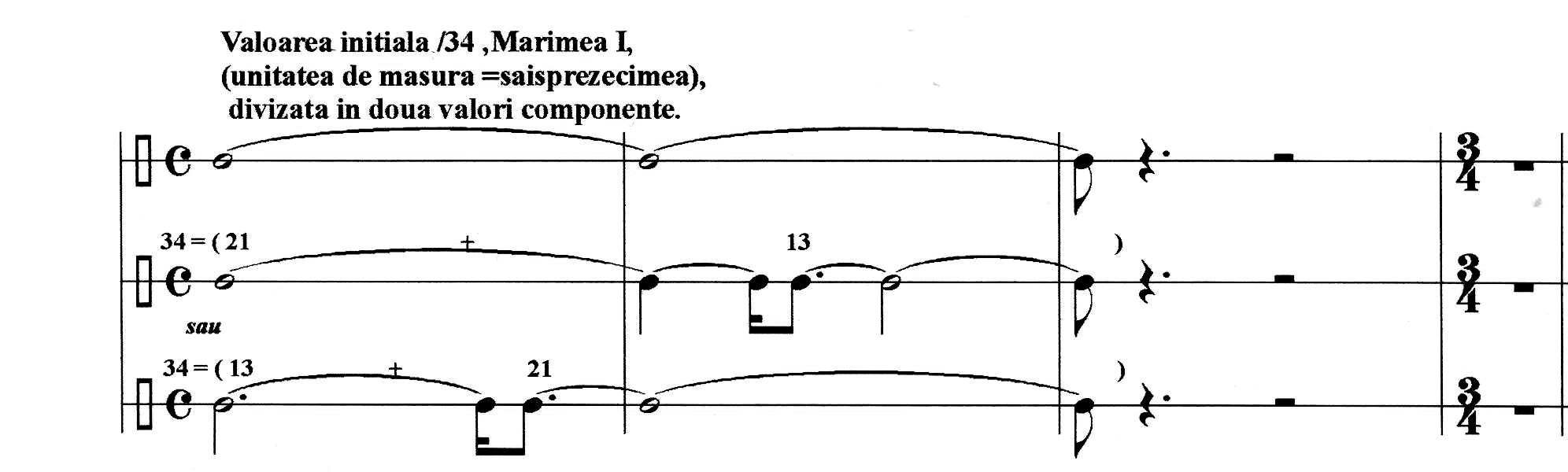
Divide a duration of 34 units, keeping the total unchanged.
A single span of 34 units.
An explanatory diagram of proportional subdivision, not a transcription or performance of a composition.
04 / COMPLEMENTARY MODES
Turn the structure.
Change its perspective.
In Noduri și Semne, the initial ascending distribution is joined by three complementary forms: a descending inversion from its upper endpoint, a descending distribution from its fundamental, and an ascending inversion from the lower endpoint of that descending distribution.
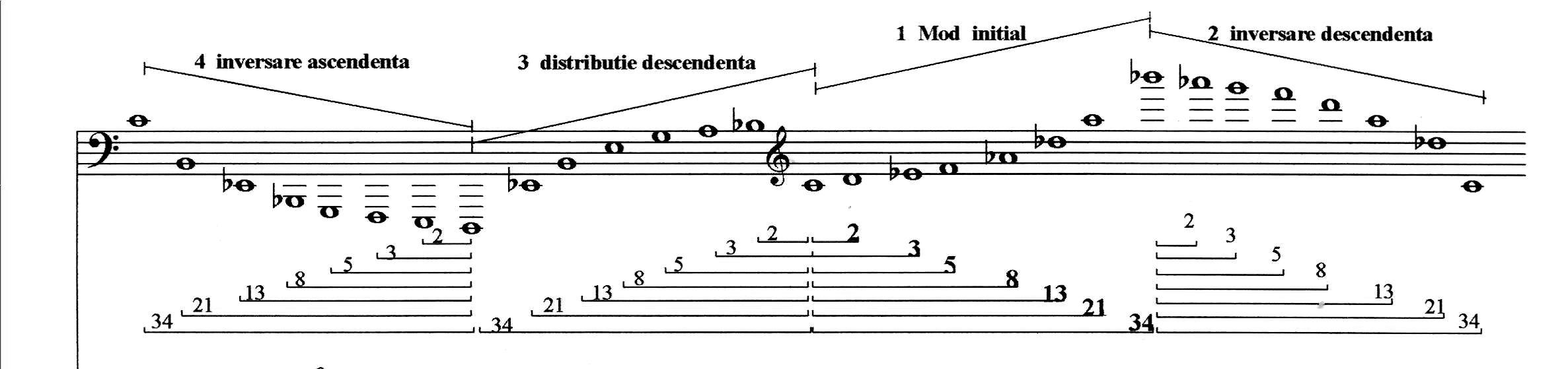
A pitch shared by two distributions can acquire a new position and numerical value. Because duration is linked to that value, the same pitch can take on a different temporal role. In Proporții 2, the thesis describes the interplay of a mode and its complement as central to the work.
05 / TIME UNFOLDS
The ornament
is also rhythmic.
Duration can be subdivided just as a pitch space can. A value of 34 units may unfold as 21 + 13, or 13 + 21; further subdivisions produce increasingly detailed rhythmic patterns. Rests participate in this organisation too.
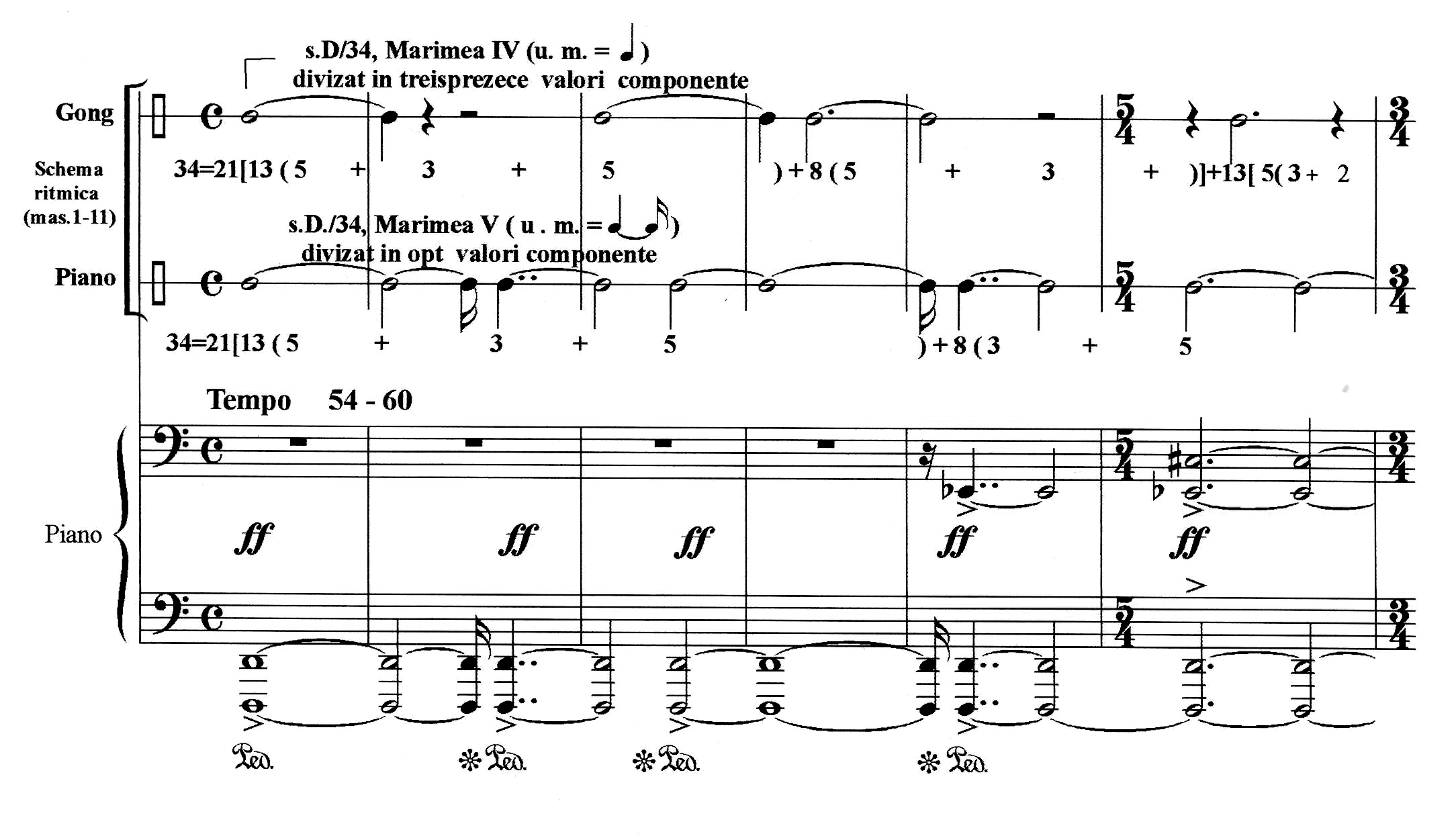
A particularly concrete example occurs in the opening eleven bars of Noduri și Semne. The piano’s D/34 uses a duration unit equal to five sixteenth notes. Its span is therefore 34 × 5 = 170 sixteenth notes. The other instruments introduce smaller patterns within that larger temporal frame.
06 / INSIDE THE MUSIC
Noduri și Semne.
Written in memory of Nichita Stănescu, the concert work brings these ideas into dialogue through oboe, clarinet, bassoon, percussion, piano, violin and cello. After the introduction, the instrumental groupings articulate the initial mode and its complements.
| Instrumental group | Modal distribution |
|---|---|
| Violin & cello | Initial ascending distribution |
| Oboe & clarinet | Descending inversion from the upper endpoint |
| Piano & percussion | Descending distribution from the fundamental |
| Bassoon & percussion | Ascending inversion from the lower endpoint |
The thesis describes the large-scale form as an introduction (bars 1–11), A (12–82), B (83–229), A₁ (230–257) and coda (258–264). Local transformations are held together within an audible, larger design.
Noduri și Semne
Listen to the work · 2001
Listen for the relationship
Follow the low piano D at the opening, then notice how changing instruments and ornaments animate the surrounding space. The numbers explain aspects of the construction; the musical experience lies in the changing colour, density, gesture and time.
Source & editorial note
Petru Stoianov, „Noduri și Semne”. Posibile elemente de structură pe scara unui model modal, Chapter Three, especially §1, §2 and the detailed analysis of Noduri și Semne. This page is an English synthesis, not a literal translation. The four reproduced diagrams and score excerpts are taken from the supplied manuscript.
The guide distinguishes the foundations drawn from Berger from Stoianov’s extension to duration and compositional practice. Explore related writings.